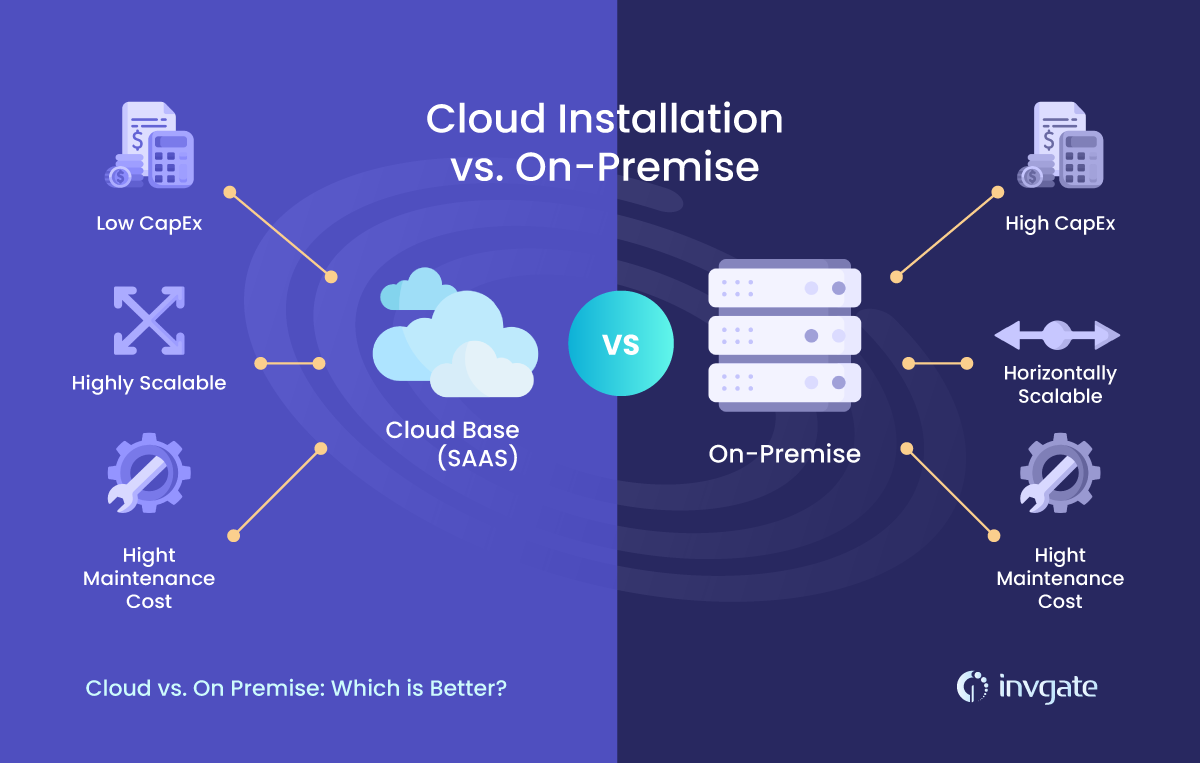
When choosing a point of sale or business management system, one of the biggest decisions isn't about features at all, but about where the software actually lives, whether in the cloud or on a server inside your own building. Both approaches can run a restaurant, supermarket, shop, hardware store, or clinic well, and the right choice depends on your budget, your internet reliability, your growth plans, and how much control you want over your own data.
Cloud-based software runs on remote servers and is accessed through the internet from any device, anywhere. You don't own the hardware, you typically pay a subscription, and updates, backups, and security happen on the provider's side. On-premise software, by contrast, runs on hardware you own and maintain, usually inside your business location. You install it once, you control the server, and your data stays physically on-site unless you choose to move it.
Cost is often the first consideration. Cloud systems generally have lower upfront costs since there's no server to buy, and you pay a predictable monthly or annual fee, which makes cloud attractive for small and growing businesses that want to avoid large one-time investments. On-premise systems usually mean a higher upfront cost for hardware and installation, but no recurring subscription fee, and over several years this can work out cheaper for businesses that plan to use the same system for a long time without frequent changes.
Internet dependence is a major factor for many businesses in Uganda and across Africa, where connectivity can be inconsistent in certain areas. Cloud systems typically need a stable internet connection to function fully, though some offer limited offline modes that sync once connectivity returns, while on-premise systems keep working during internet outages since the software and data live locally, on your own network. For a busy restaurant or supermarket that cannot afford downtime at checkout, this reliability matters.
Data control and security also differ between the two. With on-premise software, your data stays on your own server, under your own control, which some clinics and businesses handling sensitive customer or patient information prefer for compliance and peace of mind. Cloud providers, on the other hand, invest heavily in security infrastructure, encryption, and regular backups that many small businesses could not afford to replicate on their own, though the trade-off is that your data is stored off-site, managed by a third party, and accessible only through the provider's systems.
Scalability is another key difference. If you plan to open more branches, cloud software makes this much easier, letting you monitor sales, stock, and staff across multiple locations from one dashboard, in real time, from anywhere. On-premise systems can support multiple branches too, but usually require more technical setup, such as linking servers between locations, which adds cost and complexity as you grow.
Maintenance and support also work differently under each model. Cloud software is maintained by the provider, with updates, bug fixes, and new features rolling out automatically without needing an IT visit, while on-premise software puts maintenance in your hands, or requires a support contract with your vendor, giving you more control over when updates happen but also making you responsible for keeping the system running.
Cloud tends to suit businesses that want lower upfront costs, operate or plan to operate multiple branches, have reasonably stable internet access, prefer automatic updates and off-site backups, and want to check on their business from anywhere. On-premise tends to suit businesses operating in areas with unreliable internet, handling highly sensitive data and preferring full local control, planning to run the same setup for many years without frequent upgrades, having the budget for upfront hardware investment, and having in-house or contracted IT support available.
Many businesses today don't have to choose one extreme, since hybrid setups let you run core operations locally, so checkout and daily transactions continue even if the internet goes down, while syncing data to the cloud for reporting, backups, and multi-branch visibility once a connection is available. This is often the most practical choice for businesses that want reliability without giving up the convenience of cloud reporting.
There is no single right answer, only the right fit for your business. A single-location shop with a tight budget and unreliable internet may do better with on-premise or a hybrid setup, while a growing supermarket chain that wants real-time visibility across branches will likely benefit more from the cloud. Afrisap Limited builds business management and point of sale systems designed to work with the realities of African businesses, whether that means a fully cloud-based setup, a resilient on-premise installation, or a hybrid model that gives you the best of both.
← Back to Blog & News